The noise you don't notice
until it stops
Sometimes it takes everything going quiet to realise just how noisy life has become.
What does the mental load at work sound like?
A conversation with one of my clients recently made me think differently about the mental load at work.
She had come back from a two-week holiday recently, away with her family in a completely different time zone. And because of that, people couldn’t get hold of her quite as easily as they normally could.
The messages slowed down. The questions stopped coming. People weren’t constantly needing an answer or asking for something.
And she described those two weeks to me in one word:


Then she explained why.
"All the noise stopped."
She was sad.
Not simply because the holiday was over. Not the usual post-holiday blues or wishing she could still be sitting somewhere in the sunshine.
She’d experienced something she perhaps hadn’t realised she was missing.
Quiet.
For two weeks, the constant background hum of people needing things, emails waiting for replies, jobs that needed doing and things she needed to remember had faded away.
She’d stepped outside the noise.
And only then had she realised just how loud it had become.
Perhaps that’s what the mental load of work can feel like.
Nothing particularly dramatic had happened while she was away.
There wasn’t suddenly a crisis waiting for her.
Her life hadn’t become more demanding overnight.
It was simply normal life starting up again.
Emails. Messages. Appointments. Questions. Things that needed chasing. People needing answers. Little jobs waiting to be done.
Except now, after two weeks of quiet…
The noise felt incredibly loud.

And I think that’s what makes this kind of noise so difficult to recognise.
It doesn’t necessarily arrive all at once. It builds gradually.
One email isn’t overwhelming. One thing to remember isn’t a problem. One person asking a question isn’t too much.
But add another.
And another.
And another.
Until eventually you’re carrying dozens of tiny, unfinished thoughts around with you, without necessarily realising you’re doing it.
- I need to reply to that.
- Has that invoice been paid?
- I must rearrange that appointment.
- I haven’t heard back from them.
- Don’t forget Thursday.
- I need to order that.
- There was something else… what was it?
None of these things are enormous. Most aren’t even particularly difficult. Some might take five minutes to sort.
But perhaps that’s not the only way we should measure them.
How long you have been carrying them?
The Five-Minute Job That Lasts Three Days
We tend to measure a task by how long it takes us to actually do it.
Five minutes to send an email. Ten minutes to chase an invoice.
A few minutes to rearrange an appointment.
But perhaps that’s only part of the story.
- That five-minute email might first pop into your head on Monday morning. You can’t deal with it there and then, so you put it to one side.
- You remember it again later.
- And again when another email arrives.
- And again when you’re trying to concentrate on something completely unrelated.
- Finally, on Wednesday, you spend five minutes dealing with it.
So was it really only a five-minute job?
There's Actually a Name for Some of This Mental Load
Researcher Sophie Leroy coined the term “attention residue” while studying what happens when we switch between tasks.
Her research found that when we move onto something new, particularly when the previous task is unfinished, our attention doesn’t always make the move quite as neatly as we might like.
Part of it can stay behind.
We’re working on one thing, but some of our attention is still caught up in the thing we’ve just left.
And that matters, because Leroy’s research found that this lingering attention can affect how well we perform on the next task.
Which makes me look at all those little five-minute jobs rather differently.
Because the time it takes to do something and the amount of attention it takes from us aren’t necessarily the same thing.
A five-minute task can make a lot more than five minutes’ worth of noise.
When Your Brain Becomes the System
Then there’s everything we’re simply trying to remember.
- The appointment that needs moving.
- The email you’re waiting for.
- The invoice that needs chasing next week.
- The form you need to send.
- The thing you need to order before Friday.
None of it is written on your forehead.
But somehow, you’re expecting your brain to keep track of all of it.
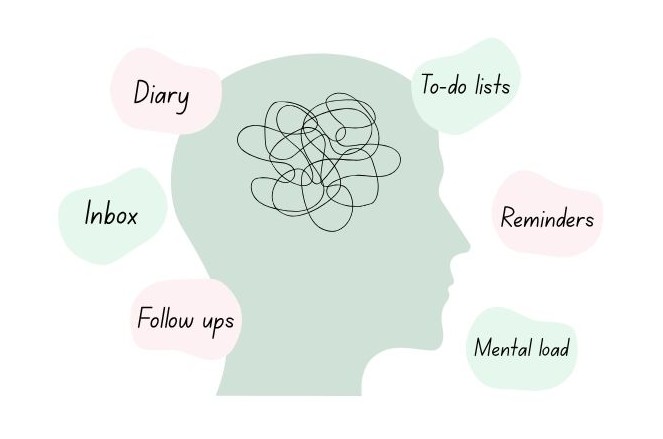
Without really meaning to, your brain has become your diary, reminder system, filing cabinet, follow-up list, inbox and to-do list.
And so it keeps doing exactly what you’ve asked it to do.
Don’t forget.
- Don’t forget to chase that payment.
- Don’t forget someone’s waiting for an answer.
- Don’t forget you moved that appointment.
- Don’t forget to send the paperwork.
- Don’t forget the thing you absolutely must remember tomorrow.
No wonder there’s noise.
Interestingly, research into unfinished goals suggests there may be something else going on here too.
Researchers E. J. Masicampo and Roy Baumeister looked at what happens when we have goals we’ve yet to complete.
Their research found that unfinished goals can remain active in our minds, intruding into unrelated thoughts. But they also found something particularly interesting.
Making a specific plan for what happens next can help.
In their studies, once people had made a plan for completing an unfinished goal, the cognitive effects associated with that unfinished business were reduced.
Perhaps, then, our brains aren’t always demanding that we do everything now. Sometimes they just need to know:
- It’s captured.
- There’s a plan.
- I don’t need to keep reminding myself.
And perhaps that’s why writing something down, putting a proper system in place or simply knowing that somebody else has it covered can feel disproportionately relieving.
The job might not even be finished yet.
But your brain doesn’t have to be the place that’s holding it anymore.
I’ve written more about the invisible workload here. You know – all those things we carry, remember and quietly keep track of.

And then we add the pings.
As if everything we’re already trying to hold in our heads wasn’t enough, there’s another kind of noise competing for our attention.
The noise that comes to us. An email arrives. A Teams message pops up. Your phone vibrates. A calendar reminder appears. Someone sends a quick “Have you got a minute?”
And each one asks us to look away from whatever we were doing, even if only briefly.
Microsoft’s 2025 Work Trend Index gives an interesting glimpse into just how fragmented our working days have become.
Looking at Microsoft 365 activity, it found that during core working hours, employees were interrupted by a meeting, email or notification every two minutes on average.
That’s potentially hundreds of little demands on our attention during a working day.
And it seems we’re feeling it too.
In Microsoft’s global survey, 48% of employees said their work felt chaotic and fragmented. More than half of leaders, 52% said the same.
Of course, not every ping is a problem.
We need to communicate. Emails need answering. Meetings need arranging. People need to be able to reach us. But perhaps it’s the cumulative effect that’s worth thinking about.
Because every notification doesn’t just bring information.
Sometimes it brings another decision to make, another thing to remember, another job to do or another person waiting for an answer.
Ping.
I’ll reply to that in a minute.
Ping.
I need to remember to send that.
Ping.
I’ll deal with that after this.
Ping.
What was I doing?
And suddenly, the noise we’ve been carrying around in our heads has company.
When the noise follows us home.

Eventually, the working day ends.
The laptop closes. You leave the office. The notifications might even stop. But that doesn’t necessarily mean the noise does.
- You can be cooking dinner and suddenly remember the email you didn’t send.
- Watching television when the thing you need to do tomorrow pops into your head.
- Getting into bed when you remember the person you meant to call back.
You’re not working.
But part of your brain still is.
And there’s research to suggest that unfinished work may play a part in this too.
A 2026 analysis brought together the findings of multiple studies looking at unfinished work and the thoughts we have about work during our time off.
The researchers found that having unfinished tasks at the end of the working day was associated with thinking about work more during our time away from it.
And perhaps that’s the part many of us recognise.
Thinking about work isn’t automatically a bad thing. We might have a great idea while walking the dog or remember something useful while making dinner.
But when unfinished work keeps pulling our thoughts back, particularly when those thoughts come with worry, frustration or tension, it can make it harder to properly switch off.
Perhaps that’s why the noise can be so exhausting.
It doesn’t always clock off when we do.
What If Some of It Didn't Belong to You Anymore?
We can’t make all the noise disappear.
There will always be emails to answer, appointments to arrange, paperwork to deal with and people who need something from us.
But what if we stopped assuming that we had to personally carry all of it?
Because handing something over isn’t necessarily just about saving the time it takes to do the task.
Sometimes the bigger difference is no longer being responsible for remembering it.
There’s a subtle difference between:
“I’ve asked Helen to do that.”
and
“Helen’s got that.”

The first means Helen’s been given a task. The second means you don’t need to think about it anymore.
- You don’t need to remember to chase it.
- You don’t need to keep checking whether it’s been done.
- You don’t need another little reminder sitting somewhere in the back of your mind.
It’s covered.
And I think that’s something we sometimes miss when we talk about getting support.
We tend to measure its value in hours.
How long would that have taken me? How many hours have I saved?
And of course, time matters.
But perhaps there’s another measure that’s just as important.
How much did you no longer have to carry?
Because sometimes completing the task isn’t actually the biggest relief.
Knowing someone else has it covered is.
The Real Thing My Clients Are Buying Isn't Admin
When people talk about outsourcing admin, we often talk about getting time back.
And yes, that’s part of it.
If someone else is managing the inbox, chasing the paperwork, keeping an eye on the diary or remembering what needs following up, that’s time you no longer have to spend doing those things yourself.
But I’ve started to think there’s something else my clients are getting back too.
Because sometimes you’re not buying back time.
You’re buying back the ability to use the time you already have properly.
To concentrate on one thing without three others nudging their way in.
To finish work without mentally taking half of it home with you.
To know something needs doing without automatically adding it to the list in your own head.
To have fewer things quietly asking for your attention.
And that’s why I’ve come to realise that the real thing my clients are buying isn’t admin.